Clarity Craft
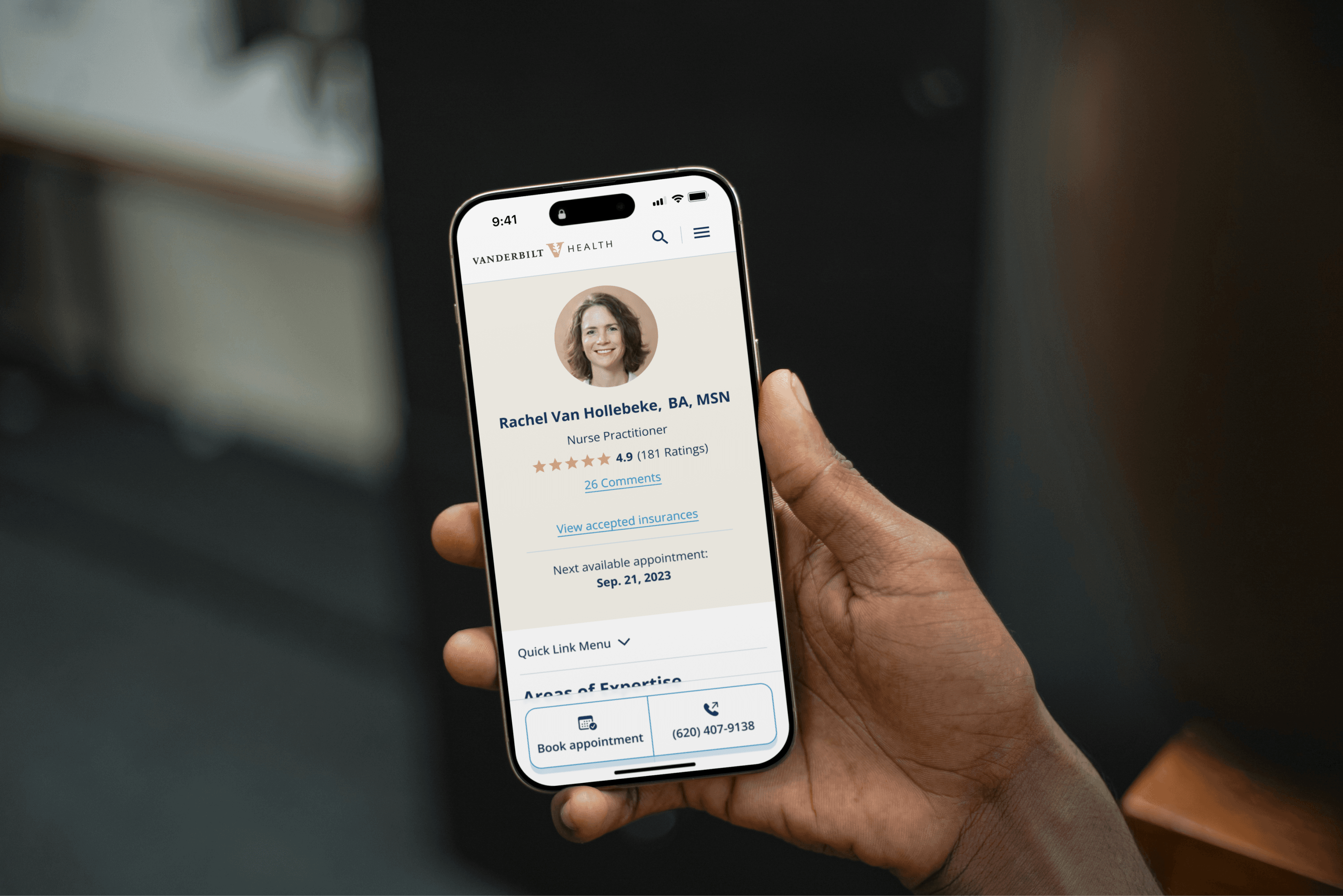
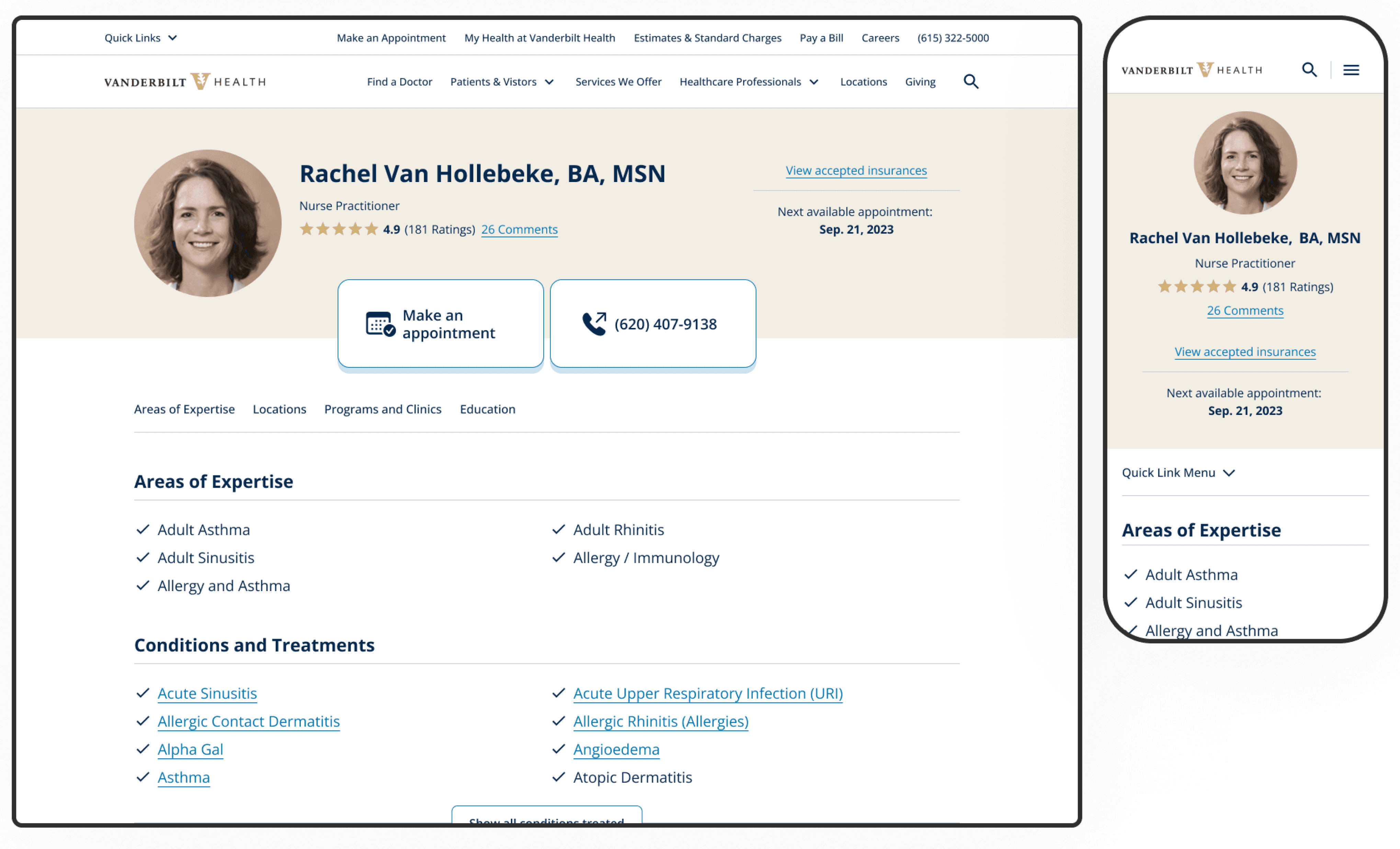
Vanderbilt Health is an academic medical center sitting as a healthcare leader in the US southeast. Their ongoing work with Modea was to maintain and enhance their expansive digital portfolio. This included their major patient consumer sites.
Business Objectives
Simplify technical architecture.
Identify user journey and engagement gaps.
Ultimately enhance the patient experience.
Outcomes
Vanderbilt considered Modea’s services a core business expense, signing multi-year contract engagements.
We kept a user-centered experience that maintained significant traffic growth, increasing 56% over a 5 month period.
Critical user journeys and their business value were identified.
Implementation became more efficient with workflows that streamlined delivery.
Comprehensive Body of User Research
I facilitated 1:1 interviews and moderated usability tests over the course of 3 years identifying opportunities to enhance the user experience. Process steps included research question alignment, gathering baseline analytics, defining test parameters to recruit ideal candidates, and devising screener and interview guides.
This work revealed critical user pain points we would build site changes to remedy. It contributed to a continuous research and implementation cycle.
Understanding the Patient Referral Experience
The product owner highlighted an assumed point of frustration within the patient scheduling experience, specifically for new patients seeking care with specialty service lines requiring referrals.
Normally when a user started online scheduling, they began a care questionnaire about their condition. What the user saw with referral only services was a list of instructions. Every step needed to be performed offline and it turned patients into the middle man in securing their care. Through user testing, I validated this experience was being met with negativity.
There wasn’t issue with referral requirement itself — what mattered was convenience and how efficiently they could get care. The interaction set expectations of an end result users couldn’t reach. The transition to a separate tab communicated significant progress when none in the way the user preferred was actually being made.
Innovating Patient Online Scheduling
These insights led to the conceptualization of a new feature: a pre-scheduling modal.
The root issues were faulty expectation setting and communicating progress that wasn’t truly made to the user. Vanderbilt’s scheduling tool couldn’t be adjusted due to another team owning it. What we did needed cohesion with the overall scheduling experience rather be a siloed experience. The solution needed to consider all of this.
Wireframes I put together mapped how the feature was connected and the contents of each piece for the following: possible entry points, body sections where users went through questionnaire decisions trees, and modal end result screens. I reviewed these with development to gut check feasibility considering the technical architecture.
The existing digital tool in reality performed two connected but distinct objectives: first assessing patient fit through questionnaires and then online scheduling. The new modal would display the first phase on the site and only transition to a new tab once a user could schedule with a doctor. This properly set expectations and communicated realistic progress.
During the first section, I chose to have all language introducing a new concept of "matching care." While “make an appointment” text on buttons were the right breadcrumb to get the user here, we needed to swiftly ground the sense of progress.
For referral-only service lines specifically, we changed button text from "make an appointment" to "learn about scheduling." This change ensured patients had the appropriate expectations about their outcome.
Design System and Cross-functional Leadership
Implementation had a lack of structure between live code and design intentions. Development slowed, code bloated, and inconsistent user experiences were implemented. I recognized an opportunity to improve through a design system.
I facilitated team conversations to understand needs, built Vanderbilt's first comprehensive design system, and initiated new delivery processes.
The design system included visual standards and a complete rebuild of components in Figma. New processes included regular design sync meetings, specifications on annotations and document design specs, and better design task story pointing and splitting.
It resulted in workflow efficiency, reduced development time, leaner technical architecture, and streamlined product delivery.
Maturing the Design System
Vanderbilt planned to merge 400+ disparate digital sites and needed governance and structure. Requirements included individualized branding for departments, template-based page creation, and a component-based editor experience.
I pitched maturing design system and positioning it as critical infrastructure in their digital portfolio. A proof of concept demonstrated team workflow mapping using the system, token system structure, and evolution of modularity.